Full arch dental implants and removable dentures both replace an entire upper or lower row of teeth, but they work in fundamentally different ways. Full arch implants are fixed to titanium posts in your jawbone and stay in your mouth, while conventional dentures rest on your gums and come out for cleaning and sleep. That single difference drives almost everything else in the comparison: how securely you can chew, what happens to your jawbone over time, how you clean your teeth each day, and what you spend now versus later.
Our team at Laudenbach Periodontics & Dental Implants regularly meets patients who are deciding between these two paths, as well as long-time denture wearers who want to know whether switching is worth it. We provide consultations through our dental implant services to help you explore both traditional removable dentures and full arch dental implant treatment, so the side-by-side comparison below reflects the questions we work through with patients every week.
Full Arch Implants vs. Removable Dentures at a Glance
The table below summarizes the practical differences most patients ask about first. Each row is explained in more detail in the sections that follow.
| Consideration | Full Arch Implants (All-on-X) | Conventional Removable Dentures |
|---|---|---|
| How the teeth stay in place | Fixed to four to six implants in the jawbone | Suction, gum contact, and often adhesive |
| Removal | Stay in; removed only by your dental team | Taken out daily for cleaning and overnight |
| Chewing and speech | Stable bite, closer to natural teeth | Can shift, especially on the lower jaw |
| Upper palate | Usually left uncovered | Upper denture typically covers the palate |
| Jawbone | Implants help preserve bone where they are placed | Bone under the denture continues to resorb |
| Treatment | Surgical placement plus healing time | No surgery; impressions and fittings |
| Upfront cost | Higher | Lower |
| Ongoing upkeep | Professional maintenance visits, occasional prosthesis repairs | Adhesives, relines, and periodic remakes as fit changes |
How Do Full Arch Implants and Dentures Compare for Stability?
The most noticeable difference between full arch implants and removable dentures is stability. Full arch implants, such as All-on-X treatments, anchor securely to your jawbone through strategically placed titanium implants, creating a fixed foundation for your new teeth. According to the American Academy of Periodontology, full mouth dental implants are more comfortable and stable than conventional dentures and allow patients to bite and chew more naturally. Many patients find they can return to firmer foods such as apples, raw vegetables, and steak once healing is complete.
Removable dentures, while more affordable initially, rely on suction, contact with the gums, and often adhesive pastes to stay in place. This tends to work better on the upper jaw, where the palate creates more surface area, than on the lower jaw, where the tongue and a narrower ridge make retention harder. Many denture wearers experience slipping, clicking, or movement during eating and speaking, which can limit food choices and make some social situations uncomfortable.
How Does Each Option Affect Your Jawbone Health?
When teeth are lost, the bone that once surrounded their roots no longer receives the stimulation it needs and gradually shrinks, which is the bone loss that naturally occurs after tooth extraction. Implants integrate with the jawbone through osseointegration and transmit chewing forces into the bone where they are placed, which helps preserve bone volume in those areas and supports your facial structure over time.
Conventional dentures sit on top of the gums rather than inside the bone, so they do not provide that stimulation. The American Academy of Periodontology notes that with conventional dentures, the bone that previously surrounded the tooth roots begins to deteriorate, which can lead to a receding jawbone and a collapsed appearance around the mouth over the years. That ongoing change is also why dentures tend to loosen and need adjustments. For patients who are losing their remaining teeth now, same-day tooth replacement options with implants can place implants and provisional teeth at the time of extraction, which may limit the period without support for the bone.
What Are the Daily Care Requirements for Each Option?
Caring for full arch implants resembles caring for natural teeth, with a few added tools. You brush twice daily with a soft-bristled toothbrush, clean under the bridge with a water flosser, interdental brushes, or floss threaders, and keep regular periodontal maintenance visits so your team can check the gum tissue and bone around each implant. There is no removal for cleaning, no overnight soaking, and no adhesive. Our guide to long-term care for full mouth implants walks through that routine step by step.
Removable dentures follow a different routine. Daily care usually involves taking the dentures out after meals to rinse them, brushing the dentures and your gums, soaking them overnight, and applying adhesive if needed. Because the gums and bone beneath a denture keep changing shape, dentures typically need periodic relines and eventually a remake to restore a comfortable fit, and how often depends on how quickly your mouth changes.
Which Option Provides Better Long-Term Value?
Full arch implants require a higher initial investment than removable dentures, and that difference is real. Over time, though, the comparison narrows for many patients once you factor in denture adhesives, relines, replacement dentures, and the effects of continued bone loss. Quality dental implant solutions using premium materials like Straumann implants can last decades with proper care, although the fixed prosthesis on top may need repairs or replacement over the years.
Your actual cost depends on how many implants you need, whether bone grafting or extractions are part of the plan, and the material chosen for your final teeth. Our overview of the cost of dental implants explains what drives those numbers, and we review a written estimate with you during your consultation.
When Removable Dentures Still Make Sense
Full arch implants are not the right answer for everyone. Conventional dentures may be the better fit if you prefer to avoid surgery, have medical conditions that make implant surgery riskier, need a lower-cost solution right now, or want a temporary option while you plan longer-term treatment. A well-made denture can still restore your smile and improve chewing compared with having no teeth at all.
There is also a middle path. An implant-supported overdenture uses two to four implants to hold a removable denture firmly in place, which improves stability at a lower investment than a fixed arch. Our article on whether implant overdentures are right for you explains that option in more depth, and our overview of full-mouth tooth replacement options compares all three approaches.
Switching From Dentures to Full Arch Implants
Many of the patients we see for full arch treatment have worn dentures for years. Switching is often possible, but the length of time without teeth matters because the jawbone may have narrowed or flattened. Our team uses 3D imaging to measure the bone that remains, and depending on what we find, treatment may involve angled implant placement or bone grafting before or during implant placement. Our article on how bone density and volume affect full arch implant planning explains what we look for.
If you are leaning toward implants, it also helps to understand the experience itself, from surgery day through healing and the first months with fixed teeth. Our guide to who benefits most from full arch implants and what to expect covers that timeline, and our article on what happens during a full arch consultation explains your first visit.
Frequently Asked Questions About Full Arch Implants and Dentures
Are full arch implants better than dentures?
For many patients, full arch implants offer a more stable bite, easier daily care, and better protection for the jawbone than conventional dentures. Dentures remain a reasonable choice for people who want to avoid surgery, have health conditions that make surgery riskier, or need a lower upfront cost. The better option depends on your health, bone, budget, and priorities, which is what a consultation is designed to sort out.
Can I switch to full arch implants if I already wear dentures?
Often, yes. Long-time denture wearers may have lost some jawbone, so the first step is 3D imaging to measure the bone that remains. Depending on the findings, treatment may use angled implant placement to take advantage of existing bone, or bone grafting to rebuild areas that are too thin. Many patients continue wearing a provisional set of teeth while they heal.
Do dentures cause bone loss?
Dentures do not cause the bone loss that follows tooth loss, but they also do not prevent it. Because a denture sits on the gums rather than in the bone, the jaw ridge beneath it continues to shrink over time. That gradual change is why dentures loosen and need relines. Implants help preserve bone where they are placed because they transmit chewing forces into the jaw.
What is the difference between an implant overdenture and a fixed full arch?
An implant overdenture is a removable denture that snaps onto two to four implants, so it is much more stable than a conventional denture but still comes out for cleaning. A fixed full arch, such as All-on-X, is attached to four to six implants and is removed only by your dental team. Overdentures typically cost less, while fixed arches feel closer to natural teeth.
How long does it take to go from dentures to full arch implants?
Many qualifying patients receive implants and a provisional fixed arch on the same day. The implants then integrate with the bone over several months before the final prosthesis is made and attached. If bone grafting is needed first, the overall timeline is longer. Your team can give you a specific timeline after reviewing your 3D scan.
Schedule Your Full Arch Consultation in Philadelphia
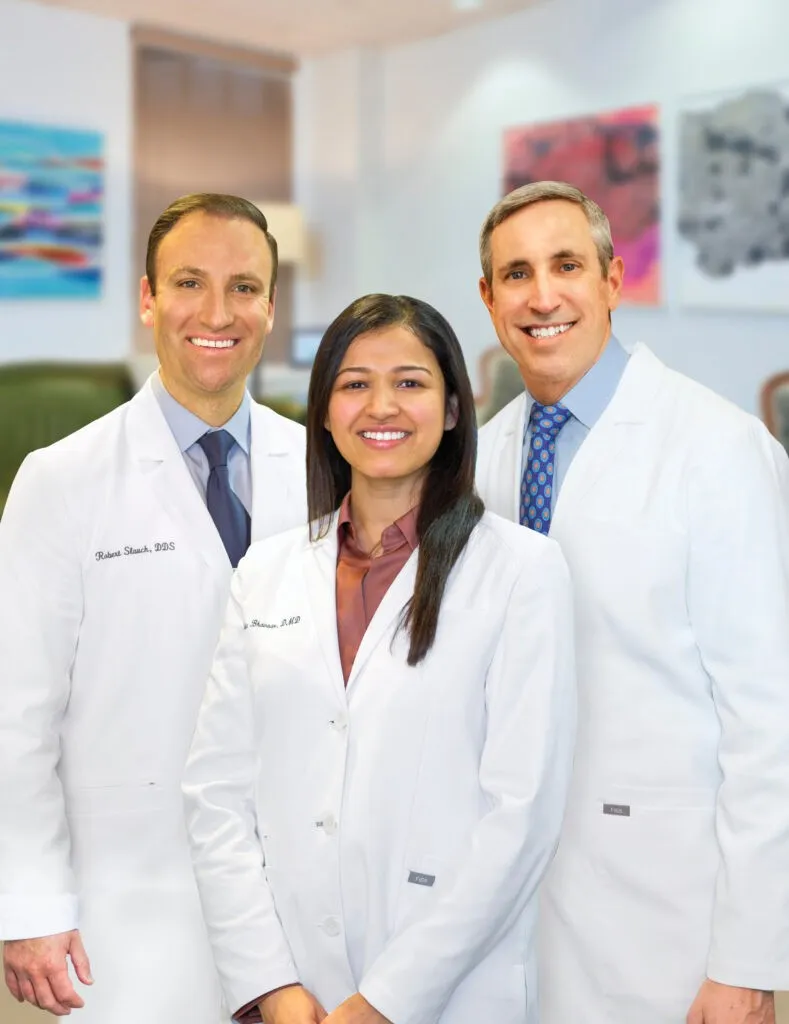
Our family-owned specialty practice combines periodontal and prosthodontic training for full arch care. Dr. Jay Laudenbach is a Diplomate of the American Board of Periodontology who completed a four-year residency in Periodontics and Periodontal Prosthesis at the University of Pennsylvania, Dr. Robert Slauch is a Diplomate of the American Board of Prosthodontics, and Dr. Ishita Bhavsar is a periodontist who is board eligible with the American Board of Periodontology. We place Straumann implants and plan each arch around your bone, bite, and goals.
Our $219 dental implant consultation includes full-mouth X-rays, a cone beam CT scan when needed, a comprehensive exam with charting of your teeth and gums, photographs, and a printed treatment plan, so you can compare implants and dentures with your own numbers in hand. Request an appointment to get started.