The biggest benefits of full arch implants are a fixed set of teeth that does not come out, a stable bite that lets you eat a wider range of foods, and implants that help preserve the jawbone where they are placed. The people who tend to gain the most are adults who are losing most of their teeth to gum disease or decay, long-time denture wearers who are tired of slipping and adhesives, and patients whose remaining teeth have become a cycle of repairs. Knowing whether you fit one of those profiles, and what the treatment experience actually involves, makes it much easier to decide whether this path is right for you.
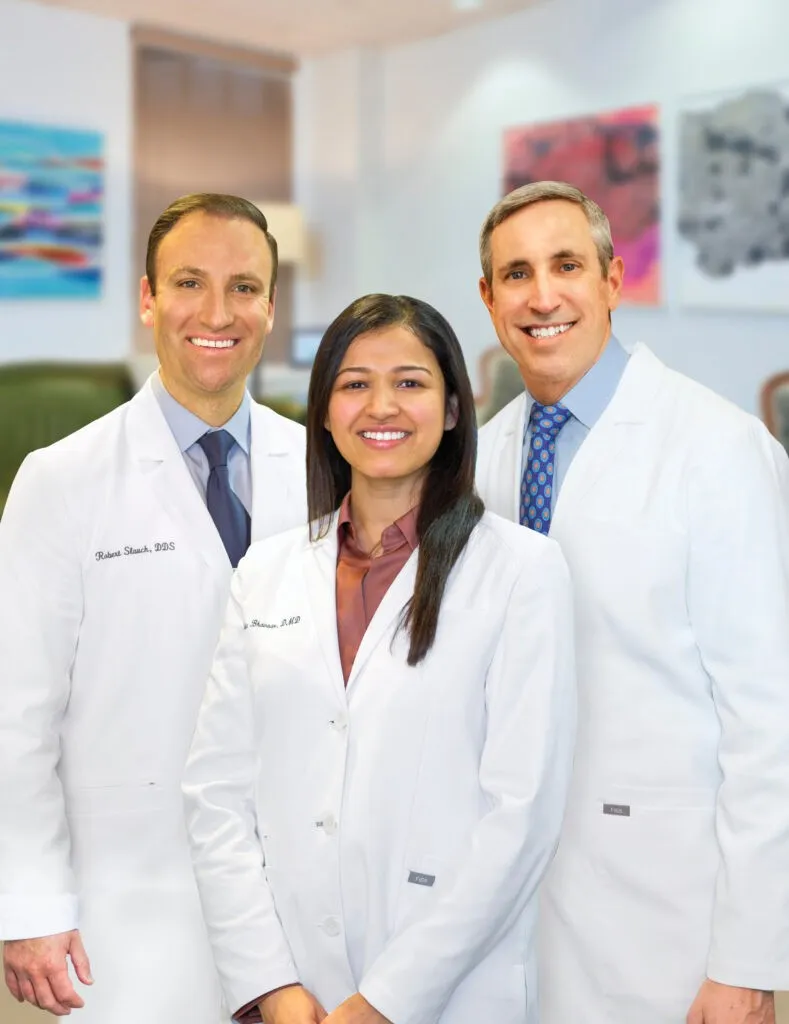
At Laudenbach Periodontics & Dental Implants, our periodontists and prosthodontist plan and place full arch dental implants in Philadelphia as a team. Led by Dr. Jay Laudenbach, Dr. Ishita Bhavsar, and Dr. Robert Slauch, our practice brings together periodontal and prosthodontic training under one roof. We place only Straumann implants and tailor every treatment plan to the individual, from initial evaluation through final restoration.
What Are Full Arch Dental Implants?
Full arch dental implants, commonly performed using the All-on-4 or All-on-X dental implants technique, replace an entire upper or lower row of teeth using four to six strategically placed titanium implant posts. These posts are surgically inserted into the jawbone, where they fuse with the bone through a process called osseointegration. A custom fixed prosthesis is then secured to the posts, giving you a complete arch of teeth that only your dental team removes. According to the American Academy of Periodontology, full mouth dental implants are designed to be long lasting and more comfortable and stable than conventional dentures, allowing patients to bite and chew more naturally.
Unlike traditional dentures, which rest on the gums and often rely on adhesives, full arch implants are anchored directly to the jawbone. If you are still weighing the two approaches, our side-by-side guide to full arch implants vs. removable dentures compares stability, bone health, daily care, and cost in detail.
Benefits of Full Arch Dental Implants
Patients who choose full arch implants often describe improvements that go well beyond their smile. These are the advantages that matter most in daily life.
- Restored chewing and diet freedom: Because full arch implants are anchored to the jawbone, you can bite with confidence once healing is complete. Many patients who avoided steak, raw vegetables, or crusty bread can return to the foods they enjoy.
- Preserved jawbone structure: After teeth are lost, the jawbone gradually shrinks. Implants transmit chewing forces into the bone much as natural roots do, which helps limit that resorption where they are placed and supports the shape of the face.
- Permanent, fixed fit: There are no adhesives, no removal at night, and no movement while speaking or laughing. Your full arch restoration stays in place, which removes much of the worry that comes with removable dentures.
- Natural appearance: Each prosthesis is custom made to match the shape, shade, and proportion you and your team plan together, so it can look natural in conversation and in photographs.
- Clearer speech: Missing teeth and loose dentures can interfere with pronunciation. A fixed arch gives the tongue and lips a stable surface to work against, and most people adjust within a few weeks.
- Same-day provisional teeth: For qualifying patients, we offer same-day tooth replacement, meaning you leave your appointment with a complete provisional smile the same day your implants are placed.
- Long-term value: With proper care and regular periodontal maintenance, Straumann implants are designed to last for decades. The prosthesis itself will likely need maintenance, repairs, or eventual replacement over the years, but the implants underneath are a long-term foundation.
Together, these advantages make full arch implants one of the most complete tooth replacement options for people missing most or all of their teeth in an arch.
Who Benefits Most From Full Arch Implants?
Full arch treatment is not only for people who have already lost every tooth. In our practice, the patients who gain the most usually fall into one of the following groups, and many fit more than one.
Adults Losing Teeth to Advanced Gum Disease
When periodontal disease has destroyed much of the bone around the remaining teeth, those teeth may loosen, drift, or become painful to chew on. Because we are a periodontal practice, we first look at whether any teeth can be saved. When the outlook for most of an arch is poor, replacing it with a fixed implant arch, after the infection is treated and controlled, can end the cycle of flare-ups and give you a stable bite again.
Long-Time Denture Wearers
People who have worn dentures for years often notice that the fit gets worse over time as the bone beneath them shrinks, especially on the lower jaw. Full arch implants can replace that removable denture with fixed teeth. The longer someone has been without teeth, the more important 3D imaging becomes, since it shows whether there is enough bone or whether grafting or angled implants are needed.
Patients With Many Failing Restorations
Some patients still have most of their teeth, but those teeth carry years of large fillings, crowns, bridges, and root canals that keep breaking down. When the cost and frequency of repairs become a burden and the long-term outlook for the teeth is poor, a planned full arch restoration can be a more predictable path than continuing to fix one tooth at a time.
Patients Told They Do Not Have Enough Bone
Limited bone is a common reason people assume they cannot have implants. Depending on the anatomy, our team may recommend bone grafting to rebuild an implant site or angled implant placement that uses the bone that is available. Our article on how bone density and volume affect full arch planning explains how we evaluate this. If you want a closer look at the general health and oral health factors involved, our guide on whether you are a candidate for full mouth tooth replacement walks through them.
What to Expect From Consultation to Final Teeth
Knowing the sequence ahead of time helps most patients feel more comfortable with treatment. Every plan is individual, but the experience usually unfolds in the stages below.
Consultation and 3D Planning
Treatment begins with a $219 dental implant consultation that includes full-mouth X-rays, a cone beam CT scan when needed, a comprehensive exam with charting of your teeth and gums, and photographs. We use those records to map where implants can go and to give you a written plan with steps, timeline, and cost. Our article on what to expect during a full arch consultation describes that first visit in detail.
Surgery Day
Any remaining teeth that cannot be saved are removed, and the implants are placed under local anesthesia, with sedation available for patients who want it. In most cases, a provisional full arch is attached the same day, so you leave with a complete set of teeth rather than a gap.
The First Few Weeks
Some soreness and swelling is normal for the first several days and is usually managed with prescribed medication and over-the-counter pain relief. During healing, we ask you to follow a soft diet so the implants are not overloaded while they begin to integrate. Most people adjust to speaking with the provisional teeth fairly quickly.
Healing and the Final Prosthesis
Over the following months, the bone grows around the implant posts. Once integration is confirmed, we take final records and attach your permanent prosthesis, which is designed for strength, fit, and appearance. For more information on what drives the cost of full arch dental implants, our team walks you through the breakdown during your consultation.
Life With Your New Arch
After treatment, your role is daily cleaning around and under the prosthesis and regular periodontal maintenance visits so we can monitor the gum tissue and bone around each implant. Our guide to how long dental implants last explains what affects longevity, and our article on maintaining full mouth implants covers the home care routine.
Full Arch Implant FAQs
How long do full arch dental implants last?
The titanium implant posts are designed to last for decades with proper care and regular professional maintenance. The fixed prosthesis attached to the posts is subject to normal wear and will likely need maintenance, repairs, or eventual replacement over the years, depending on the material and how it is cared for. Our team uses only Straumann components, which are backed by extensive long-term research.
What is the difference between All-on-4 and All-on-X?
All-on-4 refers to a specific technique using four implants per arch, while All-on-X is a broader term that covers treatment using four to six or more implants depending on the patient’s anatomy and bone structure. Our team evaluates each case individually to determine the number and position of implants that best support long-term stability and function.
Does getting full arch implants hurt?
The surgical procedure is performed under local anesthesia, and sedation options are available for patients with anxiety. Many patients report that the procedure is more comfortable than they anticipated. Some soreness and swelling in the days after surgery is normal and is typically managed with prescribed medication and over-the-counter pain relief.
Can I eat normally with full arch dental implants?
Once your implants have healed and your final prosthesis is in place, most patients can eat a wide variety of foods, including many firm and crunchy foods. During the initial healing period after surgery, we ask patients to stick to softer foods so osseointegration can proceed without disruption.
What happens if I do not have enough bone for implants?
Insufficient jawbone does not automatically rule out treatment. Depending on the degree of bone loss, our team may recommend bone grafting to rebuild the implant site, or angled implant placement that takes advantage of bone in areas less affected by resorption. A 3D scan at your consultation shows which approach fits your anatomy.
How do I care for full arch dental implants?
Daily care closely resembles caring for natural teeth. Brush twice daily with a soft-bristled toothbrush, use a water flosser or floss threaders around the implant posts and under the prosthesis, and attend regular periodontal maintenance appointments. Our hygiene team monitors the gum tissue and bone around your implants at each visit to catch early signs of peri-implant inflammation before it progresses.
Schedule Your Full Arch Consultation With Laudenbach Periodontics & Dental Implants
Full arch treatment works best when surgical and restorative planning happen together. Dr. Jay Laudenbach is a Diplomate of the American Board of Periodontology who completed a four-year residency in Periodontics and Periodontal Prosthesis at the University of Pennsylvania, Dr. Robert Slauch is a Diplomate of the American Board of Prosthodontics, and Dr. Ishita Bhavsar is a periodontist who is board eligible with the American Board of Periodontology. That combination lets us plan complex full arch cases from the foundation to the final teeth.
If you are ready to explore whether full arch dental implants are the right solution for your situation, we invite you to request an appointment online. Our $219 dental implant consultation includes X-rays, a comprehensive gum and tooth exam, photographs, and a printed treatment plan so you leave with clarity on your options and next steps.