Medically Reviewed by Dr. Robert Slauch, DDS, MDSc, FACP on July 28, 2026
If you are missing several teeth or a full arch, the three main paths back to a complete, functional smile are traditional dentures, implant-supported dentures, and full-arch dental implants, sometimes called All-on-X. Each option restores your ability to eat, speak, and smile, but they differ in cost, day-to-day comfort, appearance, and how well they preserve the bone that once supported your natural teeth. Missing multiple teeth changes more than how your smile looks. It can affect your nutrition, your speech, your confidence in social situations, and, over time, the shape of your jaw and lower face.
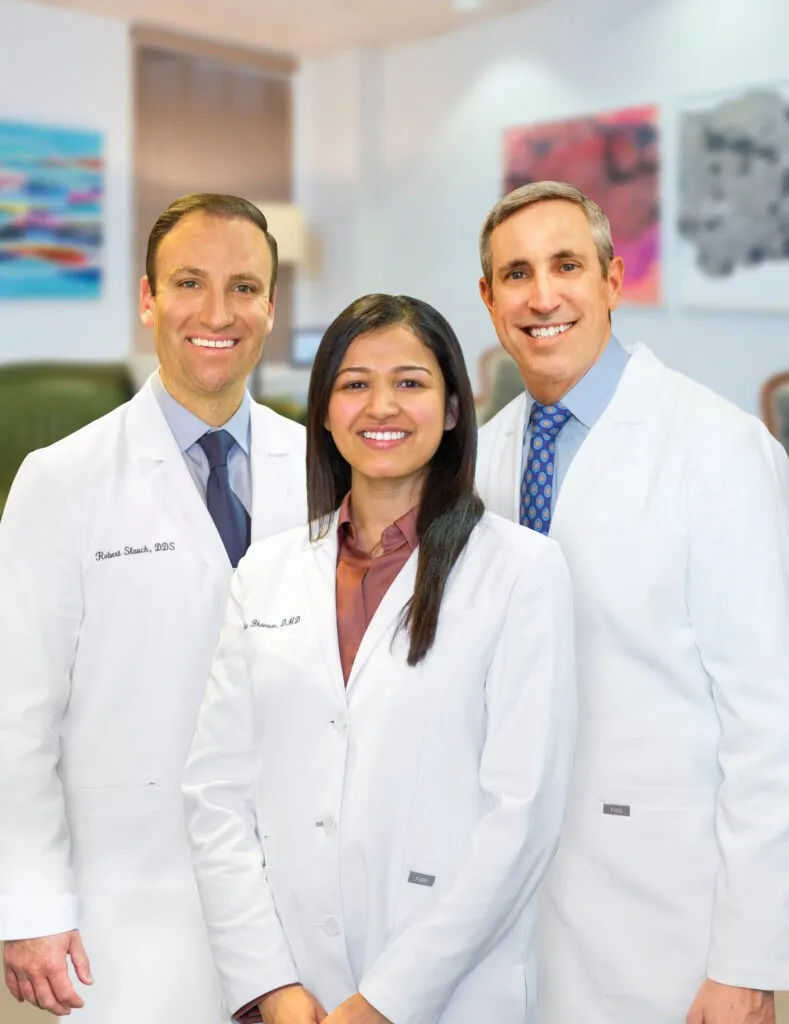
At Laudenbach Periodontics & Dental Implants, our team of specialists, including Dr. Jay Laudenbach, Dr. Ishita Bhavsar, and Dr. Robert Slauch, works with patients throughout the Philadelphia area to find the tooth replacement path that fits their oral health, budget, and lifestyle. As diplomates and board-certified specialists with decades of combined experience in full-arch care, our providers evaluate your bone structure, gum health, and goals before recommending anything, whether that means conventional dentures, dental implants, or a combination of both.
How to Know If Full-Mouth Tooth Replacement Is Right for You
Full-mouth tooth replacement is generally an option for adults who have lost most or all of their teeth in an arch, whether from decay, gum disease, or injury, and who want a longer-term solution than a single removable appliance. The right option for you depends on several factors that a periodontist or prosthodontist evaluates during a consultation, including how much healthy jawbone remains, the condition of your gums, your overall medical history, and whether you smoke, since tobacco use can slow healing after implant placement.
Patients with significant bone loss are not automatically ruled out. In many cases, bone grafting or strategic implant placement can create a stable foundation even when the jaw has begun to recede. The best way to find out whether you are a candidate for full-mouth tooth replacement is a comprehensive evaluation that includes imaging, a periodontal exam, and a conversation about your goals, budget, and timeline. Our dental implant program at Laudenbach Periodontics & Dental Implants begins with exactly this kind of individualized assessment, rather than assuming one solution fits every patient.
3 Options to Replace a Full Set of Missing Teeth
When it comes to replacing a full arch of missing teeth, three approaches consistently offer the strongest combination of function, appearance, and long-term value. Each has its own advantages, and the right choice depends on your bone health, budget, and how much stability you want day to day.
Traditional Removable Dentures
Removable dentures have restored smiles for generations and remain the most affordable starting point for replacing a full arch of teeth. These custom-fitted prosthetics rest on the gums and can be taken out for cleaning and while you sleep, which makes them simple to maintain.
Dentures do come with trade-offs. They may shift slightly while eating or speaking, often require adhesive for a secure fit, and can take some getting used to before speech feels natural again. Because dentures rest on the gums rather than stimulating the jawbone the way natural tooth roots do, the bone beneath them gradually resorbs over time. This bone loss is a normal biological response to missing tooth roots, and it can eventually change facial contours and denture fit, which is why many long-term denture wearers eventually explore implant-supported alternatives.
All-on-X Dental Implants
All-on-X, which includes All-on-4 and All-on-6 protocols, replaces an entire arch of teeth using a handful of strategically placed implants topped with a fixed, non-removable bridge. The implants themselves are small posts that act as artificial tooth roots, and they are positioned to make the most of your existing bone, which frequently reduces or eliminates the need for separate bone grafting.
Because the new teeth are fixed in place rather than removable, patients typically do not experience the shifting or slipping associated with conventional dentures. Many practices, including ours, can place temporary teeth the same day as implant surgery, so you are rarely without a functional smile during healing. Over the following months, the implants fuse with the jawbone through a process called osseointegration, which is what gives full-arch implants their long-term stability. Our All-on-X dental implants page walks through what this process looks like in more detail, including how many implants are typically needed per arch and how the final restoration is designed and attached.
Implant-Supported Dentures (Overdentures)
Implant-supported dentures, sometimes called overdentures, combine the affordability of a removable denture with the added stability of a small number of dental implants. A few strategically placed implants act as anchor points, and the denture snaps securely onto them rather than resting loosely on the gums.
This option preserves more jawbone than a conventional denture because the implants still provide some of the stimulation that natural tooth roots once did. Patients often notice they can chew more confidently and speak more clearly, without the adhesives that traditional dentures typically require. Overdentures can usually still be removed for cleaning, which some patients prefer over a fixed restoration. For many people who want more stability than a traditional denture but are not ready for, or are not candidates for, a fully fixed solution, implant-supported dentures offer a practical middle ground.
What to Expect During the Full-Mouth Replacement Process
Full-mouth tooth replacement is not a single appointment. It typically unfolds over several stages, and understanding the general timeline can make the process feel far less overwhelming.
Most treatment plans begin with a comprehensive evaluation that includes imaging, a periodontal assessment, and a conversation about which option best fits your goals. If any teeth need to be removed or bone needs to be built up before implants can be placed, that work is completed first. From there, the process generally follows a similar pattern:
- Implant placement, when posts are surgically positioned in the jawbone
- A healing period of several months as the bone fuses to the implants
- Attachment of your final restoration, whether a fixed bridge, an overdenture, or individual crowns
Throughout treatment, your care team monitors healing and adjusts the plan as needed. To learn more about what a first visit involves, our page on the full-arch implant consultation walks through what happens at that initial appointment. When you are ready to take the next step, you can complete our contact form to arrange a time to come in.
How Full-Mouth Replacement Protects Your Long-Term Oral Health
One of the most significant differences between implant-based solutions and conventional dentures is what happens to the jawbone over time. Natural tooth roots continually stimulate the bone that surrounds them, signaling the body to maintain its density and shape. When a tooth is lost and not replaced with something that provides similar stimulation, that signal disappears, and the bone gradually resorbs. This is part of why the jawbone naturally recedes in people who rely on removable dentures alone, sometimes altering facial appearance and denture fit over the years.
Dental implants are designed to replace the function of a natural tooth root, not just its visible crown. Because the implant post integrates directly with the jawbone, it continues to provide the stimulation that helps preserve bone density, which is one reason implant-supported and All-on-X solutions are often recommended for patients focused on long-term oral health rather than a short-term fix. Our page on the benefits of full-arch implants goes into more detail on how this plays out for patients considering a complete restoration.
Comparing Cost, Timeline, and Insurance Considerations
Cost is one of the first questions most patients ask, and it is a fair one. Removable dentures typically cost less upfront than implant-based options, while All-on-X and implant-supported dentures represent a larger initial investment that reflects the surgical placement, the materials used, and the specialized training involved in full-arch implant dentistry. Because every case is different, from the number of implants needed to whether bone grafting is required, the only way to get an accurate estimate is through an in-person evaluation.
Dental insurance coverage for full-mouth replacement varies widely by plan and by procedure, and some medical plans may cover portions of treatment tied to a qualifying medical diagnosis. Financing options can also make treatment more manageable by spreading costs over time. Our insurance and payment options page outlines how our office works with patients to understand coverage and explore financing before treatment begins, so cost does not have to be a barrier to finding out what is possible.
What National Data Shows About Tooth Loss and Replacement
Tooth loss is more common than many people realize, particularly later in life. According to the Centers for Disease Control and Prevention, roughly one in seven adults aged 65 and older has lost all of their natural teeth, and severe tooth loss can make it harder to eat a balanced diet of meats, fruits, and vegetables. These figures help explain why full-mouth tooth replacement has become such a well-established area of dentistry, rather than a niche or experimental treatment.
For patients and families weighing their options, this kind of context matters. Full-mouth tooth replacement is not simply a cosmetic decision. It affects nutrition, speech, and long-term oral health, which is why an individualized evaluation, rather than a one-size-fits-all recommendation, is such an important part of the process.
Choosing the Right Partner for Your Full-Mouth Tooth Replacement
Laudenbach Periodontics & Dental Implants has served patients throughout the Philadelphia area for more than 40 years, and our team includes board-certified periodontists and a board-certified, surgically trained prosthodontist who collaborate on every full-mouth case. That kind of interdisciplinary planning, with surgical placement and prosthetic design handled under one roof, helps ensure that every stage of treatment, from the initial evaluation to the final restoration, is guided by specialists trained specifically in the procedure being performed.
If you are ready to explore which full-mouth tooth replacement option fits your needs, our team can walk you through your imaging, discuss your budget and goals, and help you understand what treatment could look like for your specific situation. To take the next step, please schedule a consultation with our team.
Frequently Asked Questions About Full-Mouth Tooth Replacement
What is the difference between dentures and dental implants for full-mouth replacement?
Dentures are removable prosthetics that rest on the gums and typically need adhesive for a secure fit, while dental implants are surgically placed posts that integrate with the jawbone to support a fixed or implant-retained replacement. Implants generally offer more stability and help preserve bone density, while dentures usually involve a lower upfront cost and no surgery. The right choice depends on your bone health, budget, and how much stability you want from your new teeth.
Can I still get full-mouth tooth replacement if I have significant bone loss?
Bone loss does not automatically rule out implant-based tooth replacement. Depending on how much bone remains, your provider may recommend bone grafting, a sinus lift, or an implant placement technique designed to make use of the bone that is still available. A thorough evaluation with imaging is the only reliable way to determine which options are realistic for your specific situation.
How long does the full-mouth tooth replacement process take?
Timelines vary depending on the option chosen and whether preparatory procedures like extractions or bone grafting are needed. Removable dentures can often be completed in a matter of weeks, while implant-based solutions typically involve a healing period of several months between implant placement and the final restoration to allow the bone to fuse securely around the implants.
Does dental insurance cover full-mouth tooth replacement?
Coverage varies significantly by insurance plan and by the specific procedures involved, and some plans may cover a portion of certain steps while excluding others. Many practices, including ours, also offer financing options to help spread the cost of treatment over time. Reviewing your specific plan and discussing financing during your consultation is the best way to understand your out-of-pocket costs.
How do I care for my new teeth after full-mouth replacement?
Care depends on the option you choose. Fixed implant restorations are generally cared for like natural teeth, with regular brushing, flossing, and dental visits, while removable dentures and overdentures should be taken out for cleaning as recommended by your provider. Regardless of which option you choose, regular maintenance visits help your provider monitor healing and catch any issues early.
About the Author
Dr. Robert Slauch, DDS, MDSc, FACP
Board-Certified Prosthodontist, Fellow of the American College of Prosthodontists
Dr. Slauch is a board-certified, surgically trained prosthodontist at Laudenbach Periodontics & Dental Implants in Philadelphia, where he works alongside the practice’s periodontists on full-arch and full-mouth restoration cases. He holds board certification from the American College of Prosthodontists and is a Fellow of that organization.